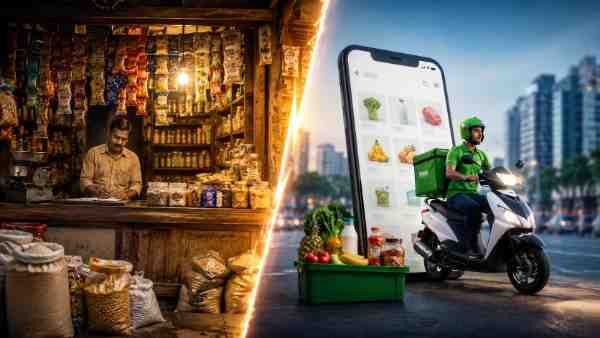
Quick Commerce vs Kirana Stores: Who Will Really Win India’s Retail War?
India’s retail industry is going through one of its biggest transformations in decades.
A few years ago, if you needed milk, bread, snacks, or household essentials, your first option was simple: walk to the nearest kirana store or call the local shopkeeper.
Today, millions of Indians open an app instead.
Blinkit promises delivery in minutes. Zepto built its brand around ultra-fast convenience. Swiggy Instamart aggressively expanded across major cities. BigBasket entered the race with strong backing and infrastructure.
This shift has triggered one major question:
Will quick commerce kill kirana stores?
At first glance, the answer seems obvious.
Why would people visit local shops when groceries arrive at the doorstep in 10–20 minutes?
But the real answer is far more complicated.
India’s kirana ecosystem is not a weak, outdated business model. It is one of the strongest retail networks in the world.
Quick commerce is powerful, but it also carries serious weaknesses.
So who wins?
Let’s break down the real economics, customer psychology, and business reality.
What Is Quick Commerce?
Quick commerce, also called q-commerce, is the rapid delivery model focused on delivering daily-use products in extremely short timeframes.
Usually within:
10 minutes
15 minutes
20 minutes
30 minutes
Popular Indian players include:
Blinkit
Zepto
Swiggy Instamart
BigBasket Now
The model depends on:
Dark stores (small mini warehouses)
Delivery fleets
Real-time inventory software
Heavy discounting
Venture capital funding
Demand forecasting systems
Instead of customers walking to stores, products move from dark stores directly to customers.
Convenience is the core selling point.
Why Quick Commerce Is Growing So Fast
The growth is not random.
It solves real customer pain points.
1. Convenience Wins
People hate interrupting work or relaxing time for small grocery runs.
Need toothpaste?
Need eggs?
Forgot baby diapers?
Quick commerce solves this instantly.
Convenience changes behavior fast.
2. Urban Lifestyle Shift
Metro city consumers value time more than ever.
Long work hours
Traffic congestion
Dual-income households
Higher disposable income
For these users, paying slightly extra is acceptable.
3. Strong Discount Addiction
Customer acquisition in India often depends on discounting.
Examples:
₹100 off first orders
Free delivery
Buy one get one offers
Cashback
This makes quick commerce attractive.
4. Smartphone Penetration
Cheap mobile internet accelerated adoption.
App-based ordering became normal.
This infrastructure shift matters.
Why People Think Kirana Stores Will Die
The fear is understandable.
Quick commerce looks extremely aggressive.
Fast Delivery
If Blinkit delivers in 10 minutes, why walk to a kirana?
Better Interface
Apps offer:
Search
Recommendations
Coupons
Multiple payment options
Order tracking
Wider Product Selection
Dark stores often stock:
Groceries
Snacks
Beauty products
Frozen food
Beverages
Household items
Personal care
Kirana stores may carry fewer SKUs.
Professional Branding
Tech companies create trust through polished design.
This influences younger consumers heavily.
But Here’s What Most People Ignore
Quick commerce is not unbeatable.
Its business model has serious weaknesses.
The Unit Economics Problem
This is where reality becomes brutal.
Let’s imagine a ₹250 grocery order.
Potential costs:
Picking cost
Packing cost
Delivery rider payout
Technology costs
Warehouse rent
Staff salaries
Customer support
Discount subsidy
Payment processing fees
Marketing
How much margin exists in groceries?
Usually very thin.
Often 5% to 20% depending on category.
That means profitability becomes difficult.
If delivery costs ₹40–₹80 and gross margin is limited, scaling profitably becomes hard.
This is why many quick commerce businesses burn huge cash.
Growth looks impressive.
Profitability is another story.
Venture Capital Can Distort Reality
Many quick commerce companies scale using investor money.
This creates artificial pricing power.
Example pattern:
Raise capital
Offer discounts
Acquire customers
Expand aggressively
Burn cash
Hope scale improves margins
This strategy works only if future economics improve.
If funding slows, discounts shrink.
Then customer behavior changes.
That’s dangerous.
Kirana Stores Have Massive Structural Advantages
This is where most analysts underestimate traditional retail.
1. Zero Delivery Cost
Customers walk to the store.
Or low-cost neighborhood delivery happens.
No expensive logistics network needed.
This is a huge advantage.
2. Low Real Estate Cost
Many kirana stores operate from owned family properties.
No expensive dark-store economics.
No premium warehouse burden.
This improves resilience.
3. Family Labor Model
Quick commerce pays employees.
Kirana stores often use family labor.
This dramatically lowers operating costs.
4. Credit System
One of the strongest kirana advantages.
Many local stores offer informal credit.
“Pay later.”
Quick commerce apps usually don’t replicate this relationship effectively.
This matters in middle-income neighborhoods.
5. Hyperlocal Customer Trust
The local shopkeeper knows customers personally.
Preferred brands
Purchase habits
Credit history
Emergency requests
This trust is hard to digitize.
The Rural and Tier 2 Reality
Quick commerce dominance is mostly a metro story.
That distinction is critical.
India is not only Mumbai, Delhi, Bengaluru, and Hyderabad.
Large parts of India still depend heavily on local retail.
Challenges for quick commerce outside metros:
Lower order density
Longer delivery routes
Lower average order values
Weak economics
Limited infrastructure
Lower willingness to pay delivery premiums
In low-density areas, quick commerce becomes harder to sustain.
Kirana stores remain naturally efficient there.
Metro India Is Different
Now the counterpoint.
In major metros, quick commerce has genuine strength.
Why?
Dense customer clusters
High order frequency
Traffic frustration
Affluent working professionals
Tech adoption
Here quick commerce becomes more viable.
This means kiranas in metro premium zones face higher pressure.
But that still doesn’t mean extinction.
Customer Psychology Matters
Humans don’t optimize perfectly.
Behavior depends on emotion.
Quick commerce wins when customers want:
Speed
Convenience
Late-night delivery
Impulse buying
Rainy-day purchases
Kirana wins when customers want:
Negotiation
Credit
Trust
Fresh inspection
Instant walking access
Relationship buying
Different use cases support different models.
Product Categories Decide the Winner
Not every category behaves equally.
Quick Commerce Strong Categories
Impulse snacks
Beverages
Emergency groceries
Personal care
Baby essentials
Late-night convenience
Small urgent purchases
Kirana Strong Categories
Bulk staples
Relationship-based recurring buying
Fresh trust-based purchases
Price-sensitive household buying
Credit-dependent purchasing
This category split matters.
Can Quick Commerce Replace Fresh Vegetable Markets?
Difficult.
Many Indian consumers still prefer inspecting produce.
Touching tomatoes
Checking onions
Selecting fruits manually
Freshness trust remains physical.
That slows digital replacement.
Discount Addiction Is Temporary
A dangerous misconception:
“Customers will always stay.”
Not necessarily.
Indian consumers are highly price sensitive.
If discounting reduces:
Order frequency may drop
Customer switching may rise
Retention becomes expensive
This creates fragile economics.
Dark Store Economics Risk
Quick commerce relies heavily on dark stores.
Risks include:
Inventory spoilage
Rent burden
Operational complexity
Demand forecasting errors
High staffing costs
Expansion mistakes
If scale assumptions fail, losses compound quickly.
Kirana Modernization Is the Wildcard
This is the biggest overlooked factor.
Kirana stores are adapting.
Digital payments
WhatsApp ordering
Local delivery boys
Inventory digitization
B2B supply apps
UPI adoption
Mini app-based ordering
A tech-enabled kirana becomes much harder to kill.
This hybrid model is powerful.
The Jio Effect Possibility
India has a history of disruption.
When infrastructure becomes cheaper, behavior changes fast.
If quick commerce improves logistics dramatically, economics could improve.
But current profitability questions remain significant.
What Happened Globally?
Global ultra-fast grocery models faced problems.
Common issues:
High burn
Weak profitability
Demand normalization
Customer retention pressure
Investor skepticism
India differs because density helps.
But the warning signs still matter.
Employment Impact
This debate is also social.
Kirana ecosystem supports millions.
Shop owners
Family workers
Distributors
Local wholesalers
Neighborhood delivery workers
Quick commerce creates jobs too:
Warehouse staff
Riders
Tech employees
Operations teams
But the structure changes.
Traditional entrepreneurship may shrink in some regions.
Gig dependence may rise.
Can Kiranas Partner Instead of Compete?
Interesting possibility.
Some kiranas may become fulfillment partners.
Others may digitize and compete hyperlocally.
Some may specialize:
Fresh produce
Regional products
Personalized service
Credit convenience
Competition doesn’t always mean destruction.
Sometimes it forces evolution.
The Real Threat to Weak Kiranas
Not every kirana survives equally.
High-risk stores:
Poor inventory
Bad customer behavior
No digital payments
Weak service
No adaptation
Limited assortment
Slow response
Modern consumers expect convenience.
Weak operators lose faster.
Strong Kiranas Can Survive
Winning kiranas usually have:
Fast response
Home delivery
WhatsApp ordering
UPI support
Clean store experience
Competitive pricing
Relationship trust
Reliable stock
These stores remain highly competitive.
Who Is Winning Right Now?
Short answer:
Both.
Quick commerce is winning urban convenience commerce.
Kirana remains dominant in broader retail reach.
The war is not finished.
Five-Year Prediction
Most realistic outcome:
Quick commerce grows strongly in metros.
Tier 1 adoption expands.
Selective Tier 2 penetration happens.
Weak kiranas disappear.
Strong kiranas adapt.
Hybrid commerce dominates.
Full kirana extinction is unlikely.
Ten-Year Prediction
Possible scenario:
Quick commerce becomes normalized urban infrastructure.
Kirana count declines in some premium clusters.
Traditional neighborhood retail survives through adaptation.
India becomes mixed-model retail economy.
Final Verdict
Will quick commerce kill kirana stores?
No—not completely.
Will it hurt many kiranas?
Absolutely.
Will weak traditional stores disappear?
Yes.
Will smart kiranas survive and even thrive?
Also yes.
The real battle is not technology versus tradition.
It is efficiency versus adaptation.
Consumers choose convenience.
But convenience alone does not guarantee sustainable business.
India’s retail future will likely belong to businesses that combine trust, speed, and operational discipline.
Quick commerce is not the end of kirana stores.
It is the beginning of a new retail evolution.