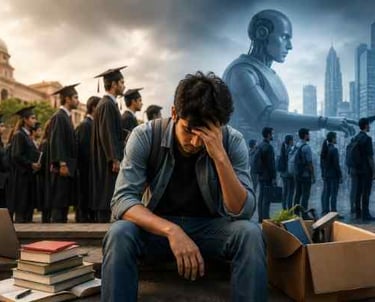
India’s Degree Crisis: Why Millions Graduate But Still Don’t Get Jobs
India produces millions of graduates every year. Engineering colleges, MBA institutes, private universities, government colleges—students spend years studying with one dream: get a stable job, earn well, and build a secure life.
Yet in 2026, a painful reality is impossible to ignore.
Thousands of graduates are jobless.
Many are working in jobs that do not require a degree.
Some are preparing endlessly for government exams.
Others are sending hundreds of resumes without receiving even one response.
So what went wrong?
Why is a country with one of the largest youth populations in the world struggling to employ its educated workforce?
The answer is uncomfortable.
It is not just the economy.
It is not just AI.
It is not just competition.
The real problem is much deeper.
This is the harsh truth behind Indian graduate unemployment in 2026.
The Degree Explosion But Jobs Didn’t Grow at the Same Speed
For years, India sold one idea to families:
Study hard. Get a degree. Get a job.
That formula worked in previous decades.
But today?
Too many degrees. Too few quality jobs.
India produces massive numbers of graduates every year across:
Engineering
BCom
BBA
MBA
BA
BSc
MCA
BCA
Law
Pharmacy
The problem is simple.
Job creation has not matched graduate production.
Imagine 10 million people entering the market while only 2–3 million decent jobs open.
What happens?
Extreme competition.
Salary collapse.
Mass unemployment.
A degree stopped being a differentiator.
Now it is just the minimum entry ticket.
Most Degrees Do Not Teach Real Job Skills
This is one of the biggest reasons.
Indian education still focuses heavily on:
Theory
Memorization
Exam writing
Attendance
Assignments
Internal marks
But employers need:
Problem solving
Communication
Software tools
Practical execution
Industry knowledge
Adaptability
A student can score 85%.
But if they cannot use Excel properly, write a professional email, present ideas, or solve real business problems, companies do not care.
This is why many graduates discover a brutal truth after college:
Their degree did not make them employable.
It only made them educated on paper.
Engineering Became Oversaturated
Engineering was once seen as the golden ticket.
Families pushed children into:
Computer science
Mechanical
Civil
Electrical
Electronics
The belief was simple:
Engineer = guaranteed job.
That era is over.
Now thousands of engineering graduates compete for the same roles.
Even worse, many graduates lack practical skills.
Recruiters regularly find candidates who cannot:
Write clean code
Solve logic problems
Build projects
Explain technical fundamentals
This creates a strange situation.
Companies say:
We have openings.
Students say:
There are no jobs.
Both are technically correct.
Jobs exist for skilled candidates.
But not for everyone with just a degree.
AI Is Killing Entry-Level White Collar Jobs
This is the 2026 reality many students underestimate.
Artificial intelligence has started replacing repetitive entry-level work.
Examples include:
Basic content writing
Customer support automation
Simple coding assistance
Data entry
Research summarization
Documentation tasks
Report drafting
Earlier, companies hired fresh graduates for these tasks.
Now AI tools can do large portions instantly.
This means fewer beginner roles.
And beginner roles are where graduates traditionally entered.
That ladder is shrinking.
If your only value is doing repetitive work, AI becomes direct competition.
India’s Outsourcing Model Is Under Pressure
For decades, India benefited massively from outsourcing.
Global companies sent work here because labor was cheaper.
That created jobs in:
IT services
BPO
Customer support
Back-office operations
Software maintenance
But the model is changing.
Why?
Automation.
AI coding assistants.
Process automation.
Global cost cutting.
Companies no longer need huge armies for repetitive work.
Even large service companies are under pressure to improve productivity.
That means fewer fresh hires compared to previous golden years.
Many students still prepare for a job market that existed 10 years ago.
That market is disappearing.
Communication Skills Are Still Shockingly Weak
This is an uncomfortable truth.
Many technically capable graduates fail interviews because of communication.
Problems include:
Poor English fluency
Weak confidence
Inability to explain thoughts clearly
Memorized answers
Lack of business communication skills
Employers do not just hire knowledge.
They hire communication.
A candidate with average technical ability but strong communication often beats a technically stronger but poor communicator.
Because teams need collaboration.
Clients need communication.
Managers need clarity.
This gap destroys employability.
Government Job Obsession Creates Hidden Unemployment
Millions of graduates are not officially “working.”
Why?
Government exam preparation.
Students spend years preparing for:
UPSC
SSC
Bank exams
Railways
State PSC
Police exams
Some succeed.
Most do not.
The problem is not ambition.
The problem is time cost.
A student may spend 4–7 years preparing.
During that time:
No experience
No income
No practical skills
Huge psychological pressure
By the time they re-enter the private market, they are older and less competitive.
This creates hidden unemployment nobody talks about enough.
Parents Still Push Outdated Career Thinking
Family pressure remains a major factor.
Common advice:
Become engineer
Do MBA
Prepare government exam
Doctor ban jao
Safe career choose karo
But the economy changed.
Digital creators earn.
Freelancers earn.
Specialized consultants earn.
AI product builders earn.
Performance marketers earn.
UX designers earn.
Video editors earn.
Sales professionals earn.
Yet many students are forced into traditional degree paths they do not even want.
This leads to:
Low motivation
Weak performance
No skill mastery
Career confusion
Private Colleges Created a Massive Quality Problem
India has thousands of colleges.
But quality varies wildly.
Some institutions produce highly employable graduates.
Many do not.
Issues include:
Outdated curriculum
Weak faculty
No industry exposure
Fake placement claims
Poor infrastructure
Little project work
Students pay lakhs expecting transformation.
Instead they get a certificate.
This is devastating.
Because graduates enter the market believing they are job ready.
Recruiters quickly prove otherwise.
Freshers Face the Experience Trap
The classic frustration:
“Need experience.”
But how does a fresher get experience?
This remains one of the biggest barriers.
Companies increasingly prefer candidates who can contribute immediately.
Training fresh graduates costs time and money.
So firms reduce fresher hiring.
Graduates then face a brutal loop:
No job because no experience.
No experience because no job.
Those who break this loop usually gain practical experience through:
Internships
Freelancing
Projects
Part-time work
Open-source contributions
Others remain stuck.
Salary Expectations vs Market Reality
Some graduates expect salaries disconnected from their skill level.
Social media worsened this.
Students see viral posts:
₹25 lakh package
₹50 lakh offer
Remote dollar jobs
But these are exceptions.
Not market averages.
A graduate with weak skills expecting premium pay often rejects realistic entry opportunities.
Meanwhile another candidate accepts, learns, grows, and advances faster.
Expectation mismatch delays employment.
The Startup Hiring Boom Slowed
There was a period when startups hired aggressively.
That changed.
Funding pressure.
Profitability pressure.
Layoffs.
AI efficiency gains.
Hiring became selective.
Instead of hiring 20 juniors, a startup may hire 5 stronger performers.
Graduates who expected startup abundance found a much tougher environment.
Resume Spam Destroyed Hiring Efficiency
Some graduates apply blindly to hundreds of jobs.
Same resume.
No customization.
No portfolio.
No strategy.
Recruiters receive thousands of low-quality applications.
Result?
Filtering becomes brutal.
Good candidates get lost in noise.
Mass application behavior hurts everyone.
Skill-Based Hiring Is Replacing Degree-Based Hiring
Employers increasingly ask:
What can you actually do?
Instead of:
Where did you study?
That shift changes everything.
Examples:
Programmer with GitHub projects beats passive degree holder.
Designer with portfolio beats certificate collector.
Marketer with campaign results beats theory student.
Writers with published work beat fresh graduates with no samples.
Degrees matter less than demonstrated ability.
Students who fail to adapt become unemployable.
Internet Created Global Competition
Earlier you competed locally.
Now you compete globally.
Remote work changed hiring.
A company can hire:
Indian candidate
Philippines talent
Eastern Europe freelancer
Latin America contractor
This raises standards.
Average graduates now compete in a much larger talent pool.
Many Students Choose the Wrong Degrees
Hard truth:
Not every degree has strong market demand.
Some fields are heavily oversupplied.
Students choose based on:
Peer pressure
Family pressure
Convenience
Low awareness
Without understanding job outcomes.
This creates predictable unemployment.
Education without market research is dangerous.
The Internship Problem
Many internships in India are broken.
Issues:
Unpaid exploitation
Fake internships
Certificate scams
No real work exposure
Students complete internships but learn nothing meaningful.
Then employers see weak practical readiness.
Internships should bridge college and industry.
Too often they fail.
Mental Health and Career Paralysis
Graduate unemployment is not just economic.
It becomes psychological.
Repeated rejection creates:
Self-doubt
Anxiety
Depression
Comparison stress
Motivation collapse
Social media makes it worse.
Watching peers post “dream job” updates damages confidence.
Eventually some graduates stop trying effectively.
This creates career paralysis.
What Indian Students Must Do in 2026
The good news?
This situation is painful but not hopeless.
The strategy must change.
1. Build Skills, Not Just Degrees
Learn tools employers actually need.
Examples:
Excel
SQL
Python
Power BI
Digital marketing
AI tools
Canva
Video editing
Sales skills
Data analysis
2. Create Proof of Work
Degrees say you studied.
Projects prove capability.
Examples:
Portfolio website
GitHub projects
Case studies
Freelance work
Writing samples
Campaign examples
3. Improve Communication
Massively underrated.
Practice:
Speaking
Presentation
Interview communication
Professional email writing
Confidence building
4. Use AI Instead of Fearing It
AI is competition if ignored.
AI is leverage if mastered.
Learn:
Prompting
Automation workflows
AI productivity tools
5. Take Internships Seriously
Even small real experience matters.
6. Stop Blind Resume Spam
Apply strategically.
Customized applications outperform mass spam.
7. Be Open to Starting Small
Career growth compounds.
First job does not define final career.
Final Truth
Indian graduates are not unemployed because they are lazy.
They are trapped inside a rapidly changing system that still teaches for an old economy while employers hire for a new one.
That mismatch is the real crisis.
Degrees alone no longer guarantee survival.
Skills, adaptability, execution, and proof of work now decide outcomes.
The harsh truth?
2026 belongs to employable learners—not just graduates.