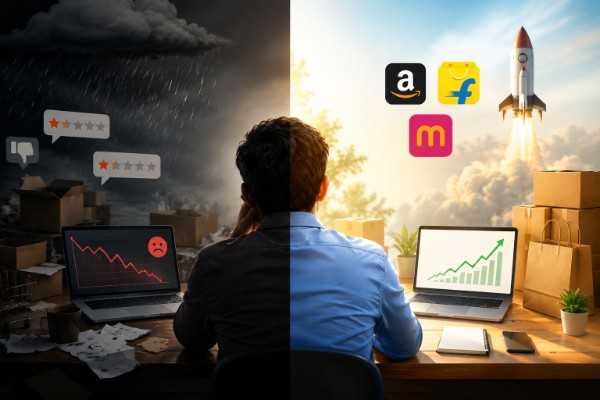
Everyone Sees Online Success… But Nobody Sees the Struggle Behind It
Open Instagram, YouTube, or reels today and you will constantly see:
Huge order screenshots.
Daily sales notifications.
Packed warehouses.
“Earn lakhs from home” videos.
It creates one dangerous illusion in people’s minds:
“Online selling is easy.”
So people invest their savings.
Some leave jobs.
Some borrow money.
Some convince their families that eCommerce will completely change their future.
Then reality hits.
Orders stop coming.
Ads waste money.
Products get returned.
Competition becomes brutal.
Slowly, excitement turns into stress.
This is the side of eCommerce most people never show online.
The Emotional Reality Most New Sellers Experience
Most beginners start with genuine excitement.
The first product upload feels exciting.
The first order feels unforgettable.
The first positive review gives confidence.
For some people, it feels like life is finally moving forward.
But after some weeks, things begin changing.
Products stop getting visibility.
Margins become smaller.
Returns increase.
Ads stop performing.
Sales suddenly slow down.
The same business that once felt exciting starts creating anxiety.
Many sellers stay awake at night refreshing dashboards repeatedly.
“Why are my sales dropping?”
“Why is my product not ranking?”
“Why are competitors selling more?”
“Did I waste my money?”
This emotional pressure is real.
Especially for small sellers who invested personal savings hoping for financial freedom.
Why Most New Sellers Actually Fail
1. They Enter a Battlefield Without Understanding Competition
Platforms like Amazon, Flipkart, and Meesho are extremely competitive in 2026.
Thousands of sellers may already be selling the exact same product.
New sellers often believe:
“If my product is good, customers will automatically buy it.”
But modern marketplaces do not work that way anymore.
Visibility depends on:
SEO optimization.
Product images.
Reviews.
Click-through rate.
Ad performance.
Delivery speed.
Conversion rate.
Without optimization, even a great product becomes invisible.
2. Most Beginners Don’t Understand Real Profit Margins
A product bought for ₹200 and sold for ₹400 does not mean ₹200 profit.
Real costs silently destroy margins:
Marketplace commission.
Shipping fees.
Return losses.
Packaging costs.
Advertising.
GST.
Damage claims.
Many sellers realize too late that high sales do not always mean real profit.
Some are actually losing money while working harder every day.
That realization mentally breaks many beginners.
3. Price Wars Destroy Small Sellers
One painful reality of Indian eCommerce is extreme price competition.
A seller may spend days creating a listing.
Then another seller appears selling the same product ₹20 cheaper.
Then another seller lowers it further.
Eventually profit margins become extremely thin.
Beginners often feel trapped:
Lower prices and lose profit.
Keep prices higher and lose sales.
This constant pressure exhausts sellers emotionally and financially.
4. Returns Hurt More Than People Think
Returns are emotionally frustrating.
Imagine this:
You carefully package products.
You pay shipping charges.
You wait for customer delivery.
Then suddenly:
“Return Requested.”
Sometimes products come back damaged.
Sometimes customers misuse products.
Sometimes fake complaints happen.
For large brands, this is manageable.
For small sellers, repeated returns feel devastating.
Especially when every order matters.
5. Most Sellers Ignore Branding Completely
This is one of the biggest mistakes.
Many sellers only focus on:
Cheap sourcing.
Fast uploads.
Trendy products.
But customers remember brands, not random listings.
Successful sellers focus on:
Better packaging.
Better presentation.
Better customer trust.
Strong brand identity.
Without branding, sellers become replaceable.
And once price becomes the only advantage, long-term survival becomes difficult.
6. They Think Products Sell Automatically
This is probably the biggest misunderstanding in eCommerce.
Uploading products is not enough anymore.
Modern eCommerce is deeply connected to:
Digital marketing.
SEO.
Product psychology.
Social proof.
Conversion optimization.
Advertising strategy.
A good product without marketing may fail.
A decent product with strong marketing can dominate.
That is the reality of online business today.
Why Some Sellers Still Become Successful
Despite heavy competition, many sellers still grow rapidly every year.
Not because they are lucky.
But because they understand:
Customer behavior.
Marketplace algorithms.
Branding.
Product positioning.
Marketing psychology.
Most importantly…
They stop thinking like small sellers and start building real businesses.
The Biggest Difference Between Failing Sellers and Growing Brands
Struggling sellers usually:
Copy trending products.
Depend only on marketplace traffic.
Ignore branding.
Ignore SEO.
Run random ads.
Compete only on price.
Growing brands focus on:
Long-term customer trust.
Better listing optimization.
Professional branding.
Better product presentation.
Organic traffic growth.
Strong digital marketing.
That difference changes everything.
Why Digital Marketing Matters More Than Ever in 2026
In today’s market, products alone rarely win.
Attention wins.
Visibility wins.
Trust wins.
This is why serious eCommerce businesses now invest heavily into:
Marketplace SEO.
Product ranking optimization.
High-converting creatives.
Social media branding.
Conversion-focused ads.
Organic traffic systems.
Customer retention strategies.
Digital marketing is no longer optional.
It has become survival.
If Your Sales Are Stuck, The Problem May Not Be Your Product
Many sellers blame:
The platform.
Competition.
Pricing.
Customers.
But often the real problem is weak optimization and weak marketing strategy.
A properly optimized business can completely improve:
Product visibility.
Conversion rates.
Customer trust.
Ad performance.
Repeat purchases.
Sometimes small strategic improvements create massive growth over time.
Need Help Growing Your eCommerce Business?
If you are struggling with:
Low sales on Amazon.
Poor visibility on Flipkart.
Inconsistent orders on Meesho.
Ads wasting money.
Low conversion rates.
Weak branding.
Then professional eCommerce marketing can make a massive difference.
DA Media Helps eCommerce Sellers Grow Faster
At DA Media, we help sellers improve:
Product listing optimization.
Marketplace SEO.
Ad campaign performance.
Brand visibility.
Organic traffic growth.
Conversion rates.
Store authority.
Social media marketing.
Whether you are a beginner seller or an existing brand struggling to scale, the right strategy can completely change your results.
Why Smart Sellers Work With Professionals
Most successful sellers understand one important thing:
Trying to do everything alone slows growth.
Professional optimization saves:
Time.
Ad budget.
Energy.
Costly mistakes.
And helps businesses grow faster in highly competitive marketplaces.
Contact DA Media for eCommerce Growth
If you want professional help growing your online business, improving visibility, increasing conversions, and scaling your store properly, contact DA Media today.
The difference between struggling sellers and growing brands is often not the product.
It is the strategy behind the business.
Final Thoughts
Most new sellers fail not because they are lazy.
But because modern eCommerce is far harder than social media makes it look.
Behind every successful online store are:
Failed experiments.
Financial pressure.
Sleepless nights.
Constant optimization.
Smart marketing decisions.
The sellers who survive are usually the ones who adapt, improve, and build trust over time.
Because in 2026, eCommerce is no longer just about selling products.
It is about building visibility, trust, attention, and a brand people remember.