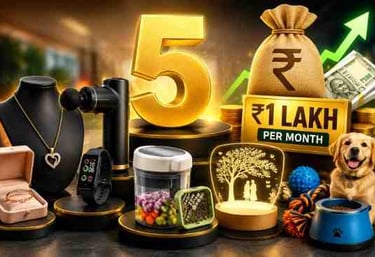
Why Product Selection Will Decide Your Dropshipping Success in 2026
Dropshipping continues to attract thousands of aspiring ecommerce entrepreneurs in India because the business model looks simple from the outside. You do not need a warehouse, you do not need to manufacture products, and in many cases you can launch a store in just a few days with relatively low upfront investment.
That accessibility is exactly why so many people enter the space.
It is also exactly why so many fail.
Most beginners assume that launching a store is the hard part. In reality, the real challenge is choosing products that actually leave enough margin after all business costs are deducted. A store can get traffic and even generate sales while still losing money.
This is where many new sellers go wrong.
They choose cheap products with little pricing power, intense competition, and low perceived value. A random gadget selling for ₹399 may attract clicks, but after advertising, payment fees, shipping costs, return issues, and customer support, the actual profit can be almost nonexistent.
If your target is building a serious business that can realistically move toward ₹1 lakh per month, product selection becomes the foundation of everything.
Winning products usually combine strong perceived value, emotional or problem-solving appeal, healthy markup opportunities, and demand that is not purely driven by temporary hype.
India presents its own unique ecommerce environment. Customers are increasingly comfortable shopping online, but trust, delivery expectations, and Cash on Delivery behavior still influence profitability. A product that works in the US may not automatically work in India with the same economics.
That is why choosing the right category matters more than copying trends.
Is ₹1 Lakh Per Month Actually Realistic?
Yes, but only if you approach the numbers realistically instead of believing exaggerated social media claims.
Many online creators make dropshipping sound like instant wealth. That is rarely how sustainable ecommerce works.
Let us break it down.
Suppose your average net profit per successful order is around ₹650 after accounting for sourcing costs, ad spend, shipping, payment gateway deductions, and operational expenses.
To reach ₹1 lakh monthly profit, you would need roughly 154 successful orders in a month.
That works out to approximately five to six profitable orders per day.
That is challenging, but it is absolutely achievable with the right product and execution.
The key phrase here is profitable orders.
A product that creates sales without margins will never help you reach meaningful income. This is why high-margin product selection matters so much.
Now let us look at the strongest product opportunities for India in 2026.
1. Customized Jewelry
Customized jewelry remains one of the most powerful ecommerce categories because it sells emotion rather than utility.
That distinction creates enormous pricing flexibility.
When a customer buys a personalized necklace with a partner’s name, a memorial pendant, or a custom bracelet marking a special occasion, they are not evaluating the product in purely practical terms. They are buying emotional meaning.
This makes customized jewelry especially profitable.
A relatively inexpensive product can be sold at a much higher price because the emotional value far exceeds the production cost.
The Indian gifting market continues to expand rapidly, particularly among younger consumers who actively purchase online for birthdays, anniversaries, Valentine’s Day, weddings, and relationship milestones.
This creates year-round demand instead of depending only on seasonal events.
Personalized necklaces, engraved bracelets, birthstone accessories, photo lockets, and couple-themed jewelry all fit strongly into this category.
A product costing ₹300 to ₹700 to fulfill can often sell comfortably between ₹1,499 and ₹3,499 depending on presentation, branding, and customization complexity.
That creates healthy margins even after advertising costs.
The psychological strength of this category is simple. Emotional purchases convert faster than purely rational ones.
Someone comparing generic accessories may hesitate.
Someone buying a meaningful gift for a loved one behaves very differently.
Of course, this category also requires operational discipline. Quality control matters, shipping speed matters, and customization accuracy matters. A supplier mistake can quickly damage customer trust.
But from a pure profit perspective, customized jewelry remains one of the strongest opportunities.
2. Smart Fitness Products
Health awareness in India continues to grow, and that trend creates strong ecommerce opportunities.
Consumers increasingly want convenience-based fitness solutions rather than complicated long-term commitments.
This is especially true among office workers, young professionals, and people trying to improve health from home.
The biggest mistake new sellers make is choosing generic fitness products that compete purely on price.
That approach rarely works well.
The stronger opportunity lies in products that solve visible problems.
Posture correction tools, recovery massagers, portable resistance systems, smart workout accessories, and convenience-focused fitness gadgets all fit well here.
The appeal is easy to understand.
A customer sees a product that appears to solve back pain, improve posture, simplify workouts, or support weight-loss efforts. That creates immediate emotional and practical motivation.
This category performs especially well in video-based marketing because transformation-focused advertising is powerful.
A static product image is weak compared to a demonstration showing clear before-and-after contrast.
A product sourced for ₹400 to ₹900 can often sell between ₹1,499 and ₹3,999 depending on positioning and branding.
That leaves room for paid acquisition costs while maintaining profitability.
The risk in this category comes from exaggerated promises. Unrealistic claims can damage credibility and create refund problems.
But with honest positioning and strong creatives, smart fitness products remain highly scalable.
3. Premium Kitchen Problem-Solving Products
Kitchen products are often underestimated because many sellers assume the category is overcrowded.
The truth is more nuanced.
Generic kitchen products face intense competition.
Problem-solving kitchen products remain highly attractive.
Consumers consistently spend money on convenience, efficiency, and organization. Products that remove everyday frustration perform particularly well because they solve immediate pain points.
This is where strong opportunities exist.
A kitchen tool that reduces preparation time, improves storage organization, minimizes mess, or simplifies repetitive tasks has natural market appeal.
The Indian household market alone makes this category enormous.
Urban families, young couples, working professionals, and homemakers all represent strong customer segments.
The strongest marketing advantage here is visual demonstration.
People love seeing products solve annoying daily problems in simple, satisfying ways.
A cluttered kitchen transformed into organized storage.
A messy cutting process replaced by a faster solution.
A wasteful oil pouring habit replaced by precise usage control.
This kind of visual storytelling performs extremely well in ecommerce ads.
Products in this category often cost between ₹200 and ₹700 to source while selling in the ₹999 to ₹2,499 range depending on positioning.
Margins can remain attractive if quality is reliable.
Competition does exist, so success depends less on choosing the category itself and more on selecting strong products with compelling creative execution.
4. Personalized Home Decor
Home decor combines emotional spending with premium pricing potential, which makes it especially attractive for dropshipping.
Modern consumers increasingly spend money on aesthetics, identity expression, and lifestyle presentation.
This trend continues to grow in India, especially among younger urban buyers influenced by social media, interior inspiration content, and gifting culture.
Personalization makes this category even stronger.
A custom family name sign or personalized decorative item feels unique in a way that generic mass-market decor does not.
That uniqueness protects margins because direct comparison becomes harder.
A buyer cannot easily compare your exact custom item with dozens of identical listings if the product feels personalized.
Products in this space may include LED name signs, personalized wall decor, custom photo frames, wedding gifts, couple-themed room accessories, or commemorative decorative pieces.
The emotional nature of gifting supports strong willingness to spend.
A product costing ₹500 to ₹1,200 to produce can often sell between ₹1,999 and ₹4,999 depending on design complexity and perceived value.
That creates substantial margin potential.
This category does require operational care.
Packaging quality becomes important because damaged decor creates obvious customer dissatisfaction.
Customization errors also create fulfillment challenges.
Still, for sellers who can manage quality properly, personalized home decor remains highly attractive.
5. Pet Products
India’s pet market is growing rapidly, and that creates major ecommerce potential.
Pet owners behave differently from standard buyers because purchasing decisions are emotionally charged.
That changes everything.
A rational shopper may aggressively compare prices for generic items.
A pet owner often spends more willingly when they believe a product improves comfort, health, convenience, or happiness for their animal.
That emotional buying behavior creates strong monetization opportunities.
Interactive toys, grooming tools, feeding accessories, travel convenience products, comfort solutions, and cleaning-related pet items all fit this category.
One major advantage is repeat purchasing potential.
Unlike one-time gift categories, pet customers often become recurring buyers if trust is established.
That dramatically improves business economics because acquiring a customer once can lead to multiple future sales.
Typical sourcing costs may fall between ₹300 and ₹900 while selling prices can comfortably reach ₹1,299 to ₹3,999 depending on branding and positioning.
That creates healthy profit room.
Marketing also becomes easier because emotional engagement is naturally strong. Cute or relatable pet-focused creatives often perform well because attention and emotional response are immediate.
For long-term ecommerce brand building, this category has serious potential.
Which Category Is Best for Beginners?
Not every category suits every founder.
If operational simplicity is your priority, problem-solving kitchen products often provide one of the easiest starting points because customization complexity is minimal.
If your goal is aggressive margin expansion, customized jewelry stands out strongly because emotional pricing power is significant.
If you are confident with video-based marketing, fitness products offer excellent scaling potential.
If you want long-term repeat customer economics, pet products become especially compelling.
If premium aesthetics and gifting appeal interest you, personalized home decor offers strong opportunity.
The best category depends on execution style, operational discipline, and marketing strength.
Final Verdict
Building a ₹1 lakh-per-month dropshipping business in India in 2026 is realistic, but only for sellers who think like business owners instead of trend chasers.
The strongest product categories are rarely random viral gimmicks.
They are products with emotional pull, strong perceived value, healthy pricing flexibility, and clear demand.
Customized jewelry, smart fitness products, premium kitchen solutions, personalized home decor, and pet products all offer legitimate high-margin potential.
Success will not come from simply launching a store and hoping for the best.
It comes from product selection, supplier discipline, persuasive marketing, operational consistency, and realistic financial management.
That is how profitable ecommerce businesses are actually built.