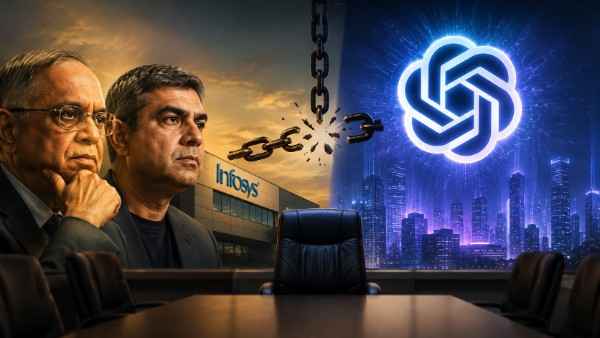
The AI Mistake That Could Have Changed Indian Tech Forever
In the history of technology, some mistakes become legendary.
Yahoo refusing to buy Google.
Blockbuster laughing at Netflix.
Kodak inventing digital cameras but failing to act.
And then there may be Infosys.
Today, OpenAI sits at the center of the artificial intelligence revolution. ChatGPT changed how people work, search, code, learn, and communicate. Microsoft invested billions. Startups built entire businesses around OpenAI’s technology. Investors who believed early saw enormous upside.
But what if one of India’s biggest tech companies had a front-row seat before all this happened?
What if Infosys had a real chance to become part of the AI future before the world understood what AI would become?
And what if internal power struggles killed that possibility?
This is the story of Vishal Sikka, Narayana Murthy, Infosys, and what may be one of Indian tech’s most painful missed opportunities.
When Infosys Needed Reinvention
By the early 2010s, Infosys was a giant.
A respected Indian IT services company.
A global outsourcing powerhouse.
A symbol of India’s software rise.
But there was a problem.
The business model that made Infosys successful was beginning to look old.
Traditional IT outsourcing was profitable, but the future was changing.
Cloud computing was rising.
Automation was accelerating.
Machine learning was becoming commercially relevant.
Clients no longer wanted just cheap manpower.
They wanted intelligence, automation, and digital transformation.
Infosys needed reinvention.
Not small adjustments.
A complete strategic reset.
That is when Vishal Sikka entered.
Who Was Vishal Sikka?
Vishal Sikka was not a traditional outsourcing executive.
That alone made him unusual.
Before Infosys, he was one of the most respected technology leaders in the enterprise software world.
At SAP, he helped lead advanced technology initiatives and became known for pushing innovation.
He understood AI before AI became a mainstream buzzword.
He thought differently from classic services executives.
While many leaders saw headcount growth as success, Sikka saw automation as the future.
This mattered.
Because Infosys wasn’t just hiring a CEO.
It was hiring a transformation architect.
In 2014, Vishal Sikka became Infosys CEO.
The expectation?
Reinvent the company.
Sikka’s AI Vision Was Years Ahead
This is where the story gets interesting.
Long before ChatGPT exploded globally, Sikka was already deeply interested in artificial intelligence.
He believed AI would fundamentally change enterprise technology.
Not eventually.
Soon.
His strategy for Infosys included:
Automation
Machine intelligence
AI-powered enterprise services
Reducing dependence on labor-heavy outsourcing
Higher-margin digital transformation work
At that time, many people thought this was too aggressive.
Traditional IT giants made money through human-intensive delivery models.
AI threatened that structure.
But Sikka believed disruption was inevitable.
And history suggests he was directionally right.
The OpenAI Connection Few People Noticed
In 2015, OpenAI was born.
At the time, it was not the giant we know today.
No ChatGPT.
No global hype.
No billions in mainstream attention.
It was a bold research initiative.
Its mission was ambitious:
Build artificial general intelligence that benefits humanity.
Most people ignored it.
Because early AI research looked speculative.
Commercial returns were uncertain.
Revenue models were unclear.
The risk was enormous.
But visionary leaders noticed.
Vishal Sikka was among those close to the early AI ecosystem.
Infosys also publicly appeared supportive of OpenAI’s early mission.
At the time, this looked like a niche experimental move.
Today, it looks historically important.
Why Early AI Investments Look Stupid Until They Don’t
Here’s the brutal truth about technology investing:
The best opportunities often look ridiculous early.
Amazon looked overpriced.
Tesla looked irrational.
Bitcoin looked absurd.
OpenAI probably looked like expensive research with no guaranteed payoff.
That is normal.
The issue is not that companies avoid every risky bet.
The issue is whether they understand asymmetric opportunities.
Because sometimes:
Small downside.
Massive upside.
That is the kind of bet that changes corporate history.
The Founder Problem Begins
Infosys has always been deeply associated with its founders.
Especially Narayana Murthy.
And to be fair, Murthy built one of India’s greatest companies.
His discipline, governance standards, and leadership shaped Infosys.
But founder influence can become complicated.
Especially after professional management takes over.
Because two power centers emerge:
Current leadership.
Legacy leadership.
That often creates tension.
And at Infosys, tension became public.
Sikka Wanted Change. The Old Guard Wanted Control.
Transformation is uncomfortable.
Especially inside established companies.
Sikka wanted speed.
Innovation.
Strategic reinvention.
Aggressive modernization.
But resistance grew.
Questions emerged around governance.
Executive decisions.
Compensation.
Acquisitions.
Strategic direction.
The founder camp raised concerns.
Supporters of Sikka saw something different.
A company resisting necessary evolution.
This is where the story becomes larger than personalities.
Because sometimes corporate conflict destroys timing.
And timing in technology is everything.
Why Timing Matters More Than Being Smart
Being intelligent is not enough.
Many smart companies understand trends.
Few act at the right moment.
BlackBerry understood smartphones.
Nokia saw Apple.
Yahoo understood search.
But timing killed them.
AI is similar.
Knowing AI matters is one thing.
Backing it aggressively before consensus forms is another.
That window is where fortunes are made.
Or lost.
Did Infosys Miss a Generational Opportunity?
This is the controversial question.
Did Infosys actually “reject OpenAI”?
The clean answer:
Not in the simplistic viral headline sense.
But strategically?
It appears Infosys failed to convert proximity into transformational ownership.
That distinction matters.
Because missed opportunity doesn’t always mean formal rejection paperwork.
Sometimes it means:
Lack of conviction.
Internal distraction.
Governance paralysis.
Strategic hesitation.
Leadership conflict.
Those factors can kill opportunity just as effectively.
Murthy vs Sikka: The Clash of Two Eras
This wasn’t just a corporate disagreement.
It represented two technology eras.
Era One
Discipline
Execution
Services excellence
Cost efficiency
Governance-first leadership
Human-capital scaling
Era Two
AI
Automation
Product thinking
High-risk innovation
Platform economics
Technology reinvention
Neither worldview is automatically evil.
But they create conflict.
Murthy represented foundational stability.
Sikka represented disruptive transformation.
And companies often struggle when both visions collide.
The 2017 Breaking Point
In 2017, the conflict exploded.
Vishal Sikka resigned as CEO.
His resignation letter strongly suggested relentless distractions and governance battles.
This was not a quiet executive transition.
It was a public rupture.
For investors, employees, and the broader technology world, the signal was ugly.
Instead of being known for AI transformation, Infosys became known for boardroom drama.
That matters because technology leadership depends on momentum.
Talent follows vision.
Markets reward confidence.
Partners trust strategic clarity.
Conflict destroys all three.
What Happened Next? The World Changed
After Sikka left, AI did not slow down.
It accelerated.
Deep learning breakthroughs expanded.
Large language models matured.
Generative AI emerged.
Then ChatGPT happened.
And suddenly the whole world understood.
AI wasn’t theoretical anymore.
It was commercial reality.
Massive reality.
Microsoft invested billions into OpenAI.
The strategic implications became obvious:
Cloud demand.
Enterprise AI tools.
Productivity transformation.
Search disruption.
Developer ecosystem dominance.
Platform leverage.
This wasn’t just another startup success.
It became infrastructure-level power.
The Numbers Are Staggering
Depending on the valuation snapshot you examine, OpenAI’s value has exploded from early uncertainty to tens or hundreds of billions.
Even a modest early strategic stake could theoretically be worth extraordinary sums.
That’s why people frame this as a multibillion-dollar miss.
Of course, hindsight makes every opportunity obvious.
Not every early AI bet succeeds.
Many fail.
But this wasn’t random.
Infosys had leadership exposure to the AI trend earlier than many peers.
That’s what makes the story compelling.
Could Infosys Have Become India’s Microsoft-Style AI Giant?
This is speculative.
But worth exploring.
Imagine if Infosys had:
Built deeper AI partnerships early
Invested strategically in frontier AI
Repositioned aggressively around automation
Retained visionary technical leadership
Created proprietary AI enterprise tooling faster
Would Infosys look fundamentally different today?
Possibly.
Instead of primarily being seen as an IT services giant adapting to AI…
…it might have been seen as a native AI transformation leader.
That is a massive branding difference.
And market difference.
Why Big Companies Often Miss Big Shifts
This pattern repeats constantly.
Why?
Because large companies optimize for predictability.
Disruption requires uncertainty.
Public companies hate uncertainty.
Innovation requires experimentation.
Experimentation creates failure risk.
Boards prefer stable returns.
Visionaries tolerate volatility.
That tension creates missed revolutions.
The same company structure that protects existing profits often blocks future breakthroughs.
Infosys is not unique.
But this example feels especially dramatic because AI became so large.
Was Narayana Murthy Wrong?
This needs nuance.
It is easy to villainize after the fact.
That would be intellectually lazy.
Murthy’s concerns reportedly centered around governance, discipline, and stewardship.
Those are legitimate priorities.
Strong governance matters.
Corporate accountability matters.
Professional management should face scrutiny.
But strategy and governance can collide.
A company can be governance-correct and innovation-wrong.
That is the uncomfortable possibility here.
Was Vishal Sikka Right?
Not automatically.
Visionary leaders are not always correct.
Some overpromise.
Some move too fast.
Some fail operationally.
But on one major question…
Did AI become central to enterprise technology?
Yes.
Massively.
That makes Sikka’s strategic instinct look remarkably strong in hindsight.
Even if not every tactical decision was perfect.
The Bigger Loss: Symbolic, Not Just Financial
The financial what-if grabs headlines.
But the symbolic loss may be bigger.
Imagine the narrative:
An Indian technology giant became one of the earliest major institutional believers in frontier AI.
That would have changed perception globally.
It could have influenced:
Talent attraction
Startup ecosystem confidence
AI investment culture in India
Global strategic positioning
Technology branding
Sometimes narrative itself creates opportunity.
Infosys may have lost more than money.
It may have lost positioning.
Lessons for Indian Tech Companies
This story contains serious lessons.
Founder Influence Must Evolve
Founders are invaluable.
But excessive shadow control can complicate transformation.
Professional management needs real room to lead.
Technology Shifts Require Speed
Waiting for certainty is dangerous.
By the time consensus forms, upside is gone.
Governance Alone Is Not Strategy
Strong controls matter.
But governance cannot replace strategic vision.
Reinvention Requires Discomfort
Transformation always creates resistance.
That does not mean transformation is wrong.
AI Is Not Optional
Companies treating AI as incremental tooling risk strategic irrelevance.
Could This Have Been Avoided?
Possibly.
Better board alignment.
Clearer governance frameworks.
Stronger communication.
Mutual trust.
Strategic patience.
Less public escalation.
Corporate history often turns on leadership relationships, not technology alone.
That is what makes this story fascinating.
AI may not have been “lost” because of technical misunderstanding.
It may have been lost because humans could not align.
The Brutal Reality of Missed Opportunities
Every major company has ghost stories.
The deal they didn’t do.
The acquisition they passed on.
The technology they dismissed.
Most stay internal.
A few become legendary.
Infosys and the AI revolution may become one of those stories.
Because when history asks:
Who saw AI early?
Vishal Sikka deserves mention.
And when history asks:
Who fully captured that opportunity?
Infosys likely will not top the list.
Final Verdict
Did Infosys literally throw away a guaranteed OpenAI fortune?
No.
That oversimplifies reality.
But did Infosys potentially miss one of the most strategically important technology opportunities of the decade because of internal conflict, hesitation, and transformation resistance?
That argument is much harder to dismiss.
And that may be the true blunder.
Not just missing an investment.
Missing a future.