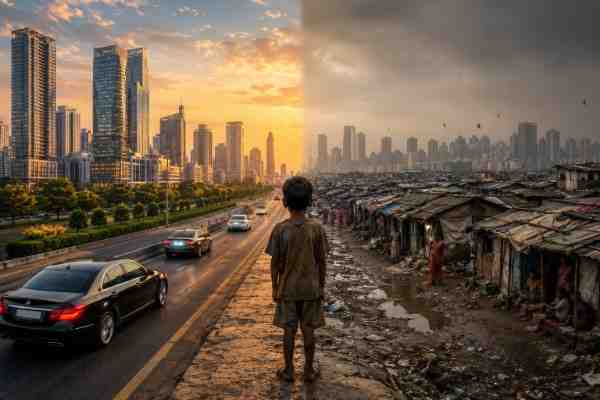
India’s Massive Economy Looks Powerful on Paper — But Daily Life Tells a Different Story
India proudly ranks among the world’s largest economies. Depending on exchange rates and yearly revisions, it sits around the top 5–6 globally by total GDP. Headlines celebrate trillion-dollar growth, booming startups, record stock markets, and billion-dollar infrastructure projects.
But then comes the obvious question:
If India is such a massive economy, why do so many ordinary Indians still struggle with low salaries, crowded cities, weak public services, pollution, expensive education, healthcare stress, and a constant financial survival mindset?
Why does a country with one of the biggest economies still have millions living in conditions that feel far removed from what “economic superpower” suggests?
The answer is simple:
Total GDP tells only part of the story.
A country can be economically huge while average citizens remain far from prosperous.
Let’s break down the real reasons.
Big Economy Does Not Mean Rich People
This is the first misconception.
India’s economy is huge because India has a huge population.
Imagine two shops:
Shop A earns $10 million with 10 employees.
Shop B earns $20 million with 10,000 employees.
Which workers are richer?
Obviously Shop A.
Same concept applies to countries.
India has over 1.4 billion people.
That means even a gigantic economy gets divided across a massive population.
This is why GDP per capita matters more than total GDP when measuring everyday prosperity.
Approximate GDP per capita comparison:
United States: $80,000+
Australia: $65,000+
South Korea: $35,000+
China: $13,000+
India: around $2,500–$3,000
This explains everything.
India’s economy is large, but when spread across 1.4 billion people, individual prosperity remains low.
That is why total GDP creates a misleading illusion.
Productivity Per Worker Is Still Low
Countries become rich when each worker produces high economic value.
Example:
A software engineer in Silicon Valley may generate hundreds of thousands of dollars of economic output.
A factory worker in Germany may operate expensive machinery efficiently.
A financial analyst in London contributes to high-value sectors.
But in India, a huge percentage of workers are still in low-productivity jobs.
Examples:
Small retail shops
Street vending
Informal labour
Low-tech manufacturing
Agriculture with low mechanization
Manual service jobs
Many people are working hard.
But hard work alone does not create wealth.
High productivity creates wealth.
If millions work in sectors generating limited economic output, wages remain low.
This is one of India’s biggest structural problems.
Too Many People Depend on Agriculture
Agriculture contributes a relatively small share of GDP but employs a huge chunk of the population.
That creates an imbalance.
A developed economy shifts workers from agriculture into:
Manufacturing
Technology
Finance
Logistics
High-value services
India’s transition has been incomplete.
Many families remain trapped in low-income agricultural dependency.
Small land holdings make farming economically weak.
Weather dependence increases risk.
Middlemen reduce farmer profits.
Low productivity limits income growth.
This keeps a large population financially vulnerable.
Informal Economy Dominates
A large percentage of India’s workforce operates in the informal sector.
That means:
No stable salary
No health benefits
No retirement security
No employment contracts
No wage protection
No productivity investment
Examples:
Construction labour
Domestic workers
Street sellers
Small repair workers
Daily wage earners
This creates survival economics rather than prosperity economics.
In developed economies, formal employment increases:
Financial stability
Consumer spending
Tax collection
Long-term investment
Household wealth creation
India still has a major informal economy challenge.
Wealth Inequality Is Massive
Economic growth does not automatically help everyone equally.
A large chunk of wealth creation often flows toward:
Top corporations
Asset owners
Urban elites
High-income professionals
Stock investors
Real estate holders
Meanwhile millions see slower gains.
That creates a visible contradiction:
Luxury malls beside slums.
Premium cars beside overcrowded buses.
Billionaires rising while average salaries stay weak.
GDP growth can happen alongside inequality.
That’s exactly what many Indians experience.
Education Quality Gap Hurts Income Growth
India has world-class talent.
Its engineers, doctors, founders, and professionals compete globally.
But average education quality remains uneven.
Problems include:
Weak foundational learning
Teacher shortages
Rote memorization
Skill mismatch
Poor rural access
Limited vocational training
Degree inflation without employability
This creates a painful outcome:
Millions are educated on paper but not job-ready for high-value work.
That suppresses income growth.
Human capital determines national wealth.
Without broad skill quality, prosperity remains concentrated.
Healthcare Costs Destroy Household Wealth
In many wealthy countries, healthcare shocks do not instantly bankrupt families.
In India, one serious illness can destroy years of savings.
Reasons:
High out-of-pocket expenses
Private healthcare dependence
Weak public infrastructure in many areas
Medicine costs
Hospital debt
Delayed treatment due to affordability
When families spend heavily on emergencies instead of investing in education or business growth, wealth creation slows.
Healthcare insecurity quietly keeps millions financially fragile.
Urban Infrastructure Struggles Under Population Pressure
Even if the economy grows fast, infrastructure must keep pace.
India faces enormous scale pressure.
Problems:
Traffic congestion
Overcrowded trains
Housing shortages
Pollution
Water stress
Poor drainage
Power inconsistency in some regions
Sanitation gaps
Rapid urbanization creates pressure faster than systems can expand.
This affects quality of life directly.
Economic size alone cannot solve execution bottlenecks overnight.
Job Creation Has Not Matched Population Growth
A growing young population can be a demographic advantage.
But only if enough quality jobs exist.
Otherwise it becomes pressure.
India adds millions of working-age people.
But job creation often lags.
Challenges include:
Automation
Weak manufacturing scale
Skill mismatch
Informal employment dominance
Slow formal hiring in some sectors
Competitive entry-level markets
This creates underemployment.
People may technically be employed but earning too little.
That’s different from prosperity.
Manufacturing Never Scaled Like China
China used manufacturing to lift hundreds of millions.
Factories created mass employment.
Exports generated huge income.
Infrastructure accelerated industrial growth.
India’s path has been different.
Manufacturing growth has faced barriers:
Regulatory complexity
Infrastructure gaps
Logistics costs
Land challenges
Skill issues
Power reliability historically
Global competition
As a result, India leaned more toward services.
Services create wealth, but not enough mass employment for all education levels.
This is a major structural reason.
Public Services Remain Uneven
Citizen lifestyle depends heavily on public systems.
Examples:
Schools
Hospitals
Roads
Transit
Water
Safety
Cleanliness
Urban planning
Some Indian regions perform much better than others.
But national consistency remains uneven.
This creates huge lifestyle inequality based on geography.
A middle-income citizen in a strong public-service country may feel richer than someone earning similar income in a weak-service environment.
Quality of life is not just salary.
It’s systems.
Housing Is Expensive Relative to Income
For many Indians, home ownership feels increasingly difficult.
Property prices in major cities are disconnected from average wages.
Rent pressure is also rising.
This creates lifestyle compression.
A large share of income goes toward:
Housing
Commute
Utilities
School fees
Healthcare
Food inflation
Leaving little discretionary wealth.
GDP growth does not automatically improve affordability.
Corruption and Inefficiency Create Economic Leakage
Economic resources lose impact when inefficiencies exist.
Leakages can happen through:
Administrative friction
Corruption
Delays
Poor project execution
Waste
Compliance complexity
Investment hesitation
Every inefficiency reduces productivity.
Less productivity means weaker prosperity.
This compounds over decades.
Cultural Pressure Toward Financial Stretching
This factor gets less discussion.
Many families face heavy social expectations:
Wedding expenses
Status spending
Family obligations
Education pressure
Multi-generational support burdens
Risk avoidance
Savings trapped in non-productive assets
Financial behavior also shapes wealth outcomes.
Income matters.
But spending structures matter too.
India Is Still Developing, Not Fully Developed
This may be the most important perspective.
India’s story is incomplete.
Large economies evolve in stages.
The US industrialized over generations.
South Korea transformed over decades.
China’s rise accelerated through manufacturing expansion.
India is still in transition.
Signs of progress:
Digital payments revolution
Infrastructure expansion
Startup growth
Manufacturing incentives
Highway development
Renewable energy growth
Financial inclusion improvements
Rising middle class
But transformation takes time.
Large populations make progress slower and more visible.
Rural vs Urban Reality Gap
Urban India can feel very different from rural India.
Economic opportunity is concentrated.
That creates a dual-speed nation.
One India:
Tech campuses
Luxury malls
Modern airports
Global startups
High-income professionals
Another India:
Agricultural dependency
Weak services
Migration pressure
Income insecurity
Limited opportunities
National GDP averages hide these realities.
Inflation Reduces Real Lifestyle Gains
Even when incomes rise, inflation can neutralize benefits.
Food prices
Fuel costs
Rent
Education
Medical expenses
Transport
Household essentials
Nominal salary growth may not feel meaningful.
Real purchasing power matters more.
That shapes daily quality of life.
Social Safety Nets Are Still Limited Compared With Rich Countries
Advanced economies often provide stronger buffers:
Unemployment support
Public healthcare
Retirement systems
Income assistance
Disability support
Social housing
India’s support systems exist but remain less comprehensive given scale.
That means individual families absorb more financial risk.
Risk lowers lifestyle stability.
Why Comparing India to Smaller Rich Countries Is Misleading
People often compare India with:
Australia
Canada
South Korea
Germany
Singapore
But scale matters enormously.
Managing prosperity for tens of millions is easier than for 1.4 billion people.
India’s challenge is civilizational scale.
That doesn’t excuse failures.
But it explains complexity.
Is India Actually Improving?
Yes.
Important improvements:
Extreme poverty reduction over long periods
Digital banking inclusion
Infrastructure modernization
Internet penetration
Startup ecosystem growth
Road expansion
Electricity access improvement
Mobile economy expansion
But expectations also rise.
So dissatisfaction remains visible.
Progress can be real while frustration remains justified.
The Core Truth
India is a big economy.
But big economy does not equal rich citizens.
The real formula for lifestyle improvement is:
High productivity + strong education + quality healthcare + mass formal employment + efficient governance + infrastructure + manageable inequality.
India has progress in some areas.
But major structural gaps remain.
That is why many Indians still feel economically stressed despite living in one of the world’s largest economies.
Final Thought
India’s headline GDP creates pride.
But ordinary life is shaped by per-person prosperity, opportunity, public systems, and affordability.
The real question is not:
“How big is India’s economy?”
The real question is:
“How much economic value reaches the average Indian household?”
That answer explains the lifestyle gap.