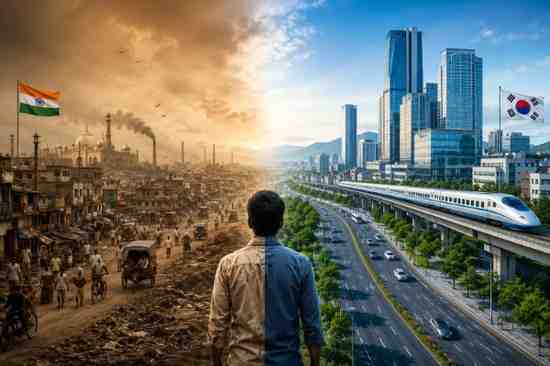
The Question Millions of Indians Ask
India became independent in 1947.
South Korea became free from Japanese rule in 1945, but just a few years later, the Korean War destroyed the country.
Cities were reduced to rubble.
Infrastructure collapsed.
Families struggled to survive.
Poverty was extreme.
On paper, South Korea should have faced a much tougher journey than India.
Yet when people compare both countries today, the difference feels shocking.
South Korea has ultra-modern cities, world-class roads, bullet trains, advanced technology, global electronics brands, powerful exports, and one of Asia’s highest living standards.
India is one of the world’s largest economies and has made major progress, but still faces infrastructure gaps, urban chaos in many regions, education inequality, pollution challenges, and bureaucratic inefficiency.
This naturally raises a difficult question.
India got independence first.
So why is South Korea so far ahead?
The answer is not emotional.
It is structural.
And understanding it reveals some uncomfortable but important truths.
South Korea Was Once Poorer Than India
Many people assume South Korea was always ahead.
That is completely wrong.
In the 1950s, South Korea was one of the poorest countries in the world.
The Korean War destroyed factories, homes, transport systems, and much of the economy.
Foreign aid became essential.
India, by comparison, had stronger institutions, a larger economy, and far greater natural advantages.
If someone had compared the two nations back then, many would likely have predicted India would dominate.
But development is not decided by potential alone.
It is decided by execution.
That is where the story changed.
Education Became South Korea’s Survival Weapon
South Korea understood something very early.
The country had limited natural resources.
It could not rely on oil wealth.
It did not have India’s massive domestic market.
Its biggest national asset would have to be human intelligence.
That changed everything.
Education became a national obsession.
Schools expanded rapidly.
Literacy improved.
Mathematics and science became core priorities.
Engineering education strengthened.
Parents pushed children aggressively toward academic success.
Teachers were treated seriously.
The country built a culture where education was directly linked to national survival.
That produced a highly skilled workforce.
Factories need disciplined workers.
Technology companies need engineers.
Research ecosystems need educated talent.
Education became the foundation for economic growth.
India also produced brilliant minds.
Indian engineers, scientists, doctors, and entrepreneurs are respected globally.
But India’s challenge was completely different.
Educating 1.4 billion people is not remotely comparable to educating 50 million.
Scale changes everything.
Rural access, uneven school quality, state-level differences, infrastructure gaps, and inconsistent learning outcomes made national transformation slower.
India built world-class talent at the top.
South Korea raised the national average faster.
That difference matters enormously.
Manufacturing Changed South Korea’s Destiny
One of the biggest reasons South Korea moved ahead was manufacturing.
The country made a deliberate decision.
It would not remain poor.
It would build industries that could compete globally.
Factories became engines of transformation.
South Korea invested heavily in steel, automobiles, shipbuilding, electronics, machinery, and eventually semiconductors.
This changed the economic structure completely.
Manufacturing creates jobs at scale.
It builds technical knowledge.
It attracts investment.
It improves productivity.
It strengthens exports.
It creates wealth.
Over time, South Korea produced global giants.
Samsung became a technology empire.
Hyundai became an automotive powerhouse.
LG became globally recognized.
Kia expanded internationally.
These companies did not just create profits.
They transformed the country.
India’s economic path was different.
For decades, India operated under the License Raj.
This system created heavy bureaucracy and restrictive controls.
Starting businesses was harder.
Scaling industries was slower.
Importing machinery was complicated.
Competition was weaker.
Entrepreneurial momentum suffered.
India liberalized in 1991, which changed the trajectory significantly.
But South Korea had already spent decades accelerating industrial growth.
Time compounds.
Starting earlier creates huge long-term advantages.
Population Size Is a Massive Hidden Reason
This is one of the most ignored factors.
South Korea has roughly 50 million people.
India has over 1.4 billion.
That difference changes everything.
Governments must provide schools, roads, hospitals, electricity, transport systems, water infrastructure, and employment opportunities.
Doing that for 50 million people is challenging.
Doing that for 1.4 billion is one of the hardest governance tasks on Earth.
This does not excuse policy mistakes.
But it explains why direct comparisons can be misleading.
A smaller country can often move faster simply because execution complexity is dramatically lower.
India’s scale is both its greatest strength and one of its biggest operational burdens.
Infrastructure Was Built Faster
Infrastructure is one of the most underrated development factors.
People notice glamorous technology.
But roads, ports, power grids, transport systems, and logistics quietly determine economic performance.
South Korea invested aggressively in infrastructure.
Roads improved rapidly.
Ports became efficient.
Urban transport became reliable.
Industrial zones were built strategically.
Electricity became stable.
Telecommunications improved quickly.
This matters because businesses hate friction.
Factories cannot function efficiently with transport bottlenecks.
Exports become expensive when ports are slow.
Investors avoid uncertainty.
South Korea reduced friction.
India has made major progress in infrastructure, especially in recent years.
But historically, execution was slower.
Land disputes, bureaucracy, legal complexity, political fragmentation, and funding constraints often delayed projects.
Infrastructure speed changes national outcomes more than most people realize.
South Korea Built for Global Competition
South Korea understood a harsh reality.
Its domestic market was not enough.
If the country wanted prosperity, it needed to sell to the world.
That forced competitiveness.
Global competition is brutal.
Products must be reliable.
Pricing must be efficient.
Quality must be high.
Delivery must be consistent.
Weak companies fail quickly.
This pressure improves productivity.
South Korean firms were forced to become globally competitive.
That sharpened the entire economy.
India had a huge domestic market.
That can be an advantage.
But it can also reduce urgency.
When domestic demand is strong, international competitiveness may develop more slowly.
South Korea had no such luxury.
It had to compete globally.
That changed everything.
Government and Industry Worked Together
South Korea’s development model involved strong coordination between government and major businesses.
The state strategically supported industrial expansion.
Financing, infrastructure support, export incentives, and policy direction helped accelerate growth.
This helped build giant industrial groups.
The model had critics.
Some argued it concentrated too much economic power.
That criticism is valid.
But in terms of growth speed, the model worked.
India historically followed a different approach.
The state controlled major sectors directly.
Private businesses often faced restrictions.
Decision-making moved slower.
Efficiency suffered in many areas.
Economic liberalization improved conditions later.
But decades had already been lost.
Timing matters enormously.
Technology Upgrading Made South Korea Richer
Many countries manufacture basic products.
Far fewer move into advanced technology.
South Korea kept upgrading.
It moved from low-cost manufacturing into high-value innovation.
Today, South Korea dominates industries such as semiconductors, advanced electronics, battery technology, automotive engineering, and display manufacturing.
These industries generate enormous wealth.
They require research, engineering, capital, and long-term planning.
India has strong technology sectors too.
Its software industry is globally respected.
Its startup ecosystem is vibrant.
Its digital payments revolution is remarkable.
Its pharmaceutical sector is powerful.
Its space program is impressive.
But high-end industrial manufacturing remains less dominant.
That affects national income and export composition.
Discipline and Social Pressure Played a Role
This is controversial but relevant.
South Korea developed a highly disciplined performance culture.
Students face intense academic pressure.
Work expectations are demanding.
Competition is fierce.
This contributed to productivity and growth.
But it also created social costs.
Stress levels are high.
Work-life balance suffers.
Mental health pressures exist.
Birth rates have collapsed.
Economic success came with trade-offs.
India’s social environment is much more diverse and decentralized.
Different states, communities, and regions operate differently.
This creates flexibility but also uneven development outcomes.
Culture influences economic behavior more than many people admit.
Urban Planning Helped South Korea Move Faster
Economic productivity depends heavily on city efficiency.
South Korea urbanized in a more organized way.
Dense infrastructure reduced costs.
Public transport became effective.
Commuting improved.
Business operations became smoother.
Cities became engines of productivity.
India’s urbanization often expanded in a more chaotic way.
Rapid migration, informal settlements, planning limitations, traffic congestion, and aging infrastructure created inefficiencies.
When cities become inefficient, national productivity suffers.
Urban design matters much more than most people think.
Bureaucratic Speed Made a Big Difference
Economic growth needs fast decisions.
When approvals take too long, investors lose interest.
Projects become expensive.
Momentum dies.
Historically, India struggled with red tape.
Complex approvals slowed progress.
Administrative uncertainty increased business costs.
South Korea generally moved faster.
Faster approvals create confidence.
Confidence attracts capital.
Capital creates growth.
Growth creates jobs.
That cycle becomes self-reinforcing.
Speed matters.
India Reformed Much Later
This is one of the most important reasons.
India’s major economic liberalization happened in 1991.
Before that, economic restrictions slowed business dynamism.
South Korea had already spent decades industrializing aggressively.
Development compounds over time.
Even small annual growth advantages become massive over decades.
This timing difference created a huge structural gap.
South Korea Built Powerful Global Brands
Economic power is not only about factories.
It is also about influence.
South Korea built brands the world recognizes instantly.
Samsung.
Hyundai.
LG.
Kia.
K-pop.
Korean dramas.
Korean cinema.
Beauty products.
This creates soft power.
Soft power improves tourism, exports, investment appeal, and global reputation.
India has immense cultural influence too.
But commercial global branding has been less concentrated and strategically packaged.
Brand power translates into economic value.
Per Person Wealth Tells the Real Story
Total GDP comparisons can be misleading.
India’s economy is huge because its population is huge.
Per capita wealth gives a clearer picture of average living standards.
South Korea’s average citizen is dramatically wealthier.
That affects healthcare access.
Consumer purchasing power.
Public infrastructure quality.
Education quality.
Daily convenience.
This is why visual comparisons feel so striking.
Did India Fail?
No.
That would be lazy thinking.
India achieved extraordinary things.
Its IT industry became globally dominant.
Its pharmaceutical manufacturing became world-class.
Its digital payment ecosystem transformed finance.
Its startup ecosystem expanded rapidly.
Its space program achieved remarkable milestones.
Its democratic continuity at massive scale is historically significant.
India did not fail.
India faced a vastly more difficult structural challenge.
But potential alone does not create outcomes.
Execution does.
Can India Catch Up?
Absolutely.
India still has enormous strengths.
A young population.
Massive entrepreneurial energy.
A huge internal market.
Growing digital infrastructure.
Manufacturing potential.
Strategic geopolitical relevance.
But catching up requires relentless execution.
Education quality must improve.
Manufacturing competitiveness must scale.
Infrastructure expansion must accelerate.
Bureaucratic complexity must reduce.
Urban planning must improve.
Innovation investment must deepen.
Potential without execution remains wasted opportunity.
Final Verdict
India got independence first.
South Korea suffered war, destruction, and extreme poverty.
Yet today South Korea appears far ahead in several measurable dimensions.
The reason is not magic.
The reason is decades of focused execution.
Education.
Manufacturing.
Exports.
Infrastructure.
Technology.
Administrative speed.
Strategic industrial policy.
India’s future is still unwritten.
Its scale makes progress harder.
But its upside remains enormous.
The real question is no longer why South Korea moved ahead.
The real question is whether India can turn its massive potential into disciplined long-term execution over the next twenty years.