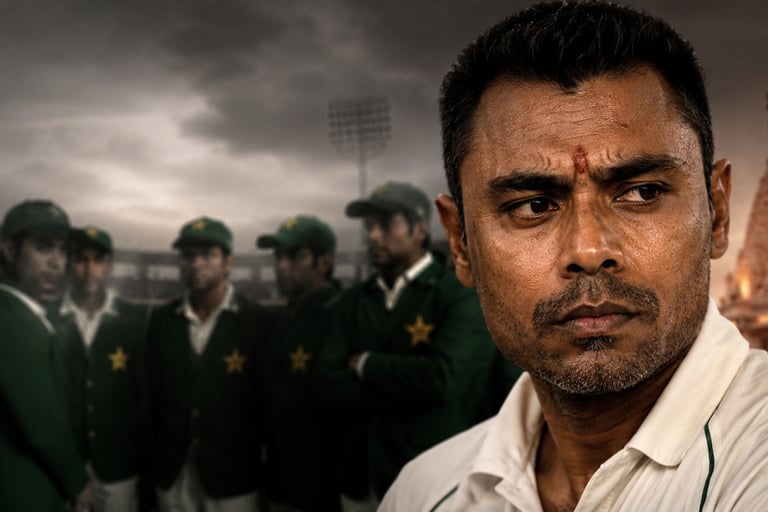
The Rise and Fall of Pakistan’s Only Hindu Cricket Star
Cricket in Pakistan has always been more than just a sport. It is tied to national pride, religion, politics, identity, and emotion. Millions of people worship cricket stars like heroes. Stadiums become battlefields of nationalism, and players often carry the expectations of an entire country on their shoulders.
But hidden behind the celebrations and records are stories that rarely get told.
One of those stories belongs to Danish Kaneria.
For years, Danish Kaneria was one of Pakistan’s most successful spin bowlers. He took wickets across the world, troubled top batsmen, and became one of the few Pakistani leg-spinners to achieve major international success after Abdul Qadir.
Yet despite his performances, many believe his journey inside Pakistan cricket was never equal.
Why?
Because Danish Kaneria was Hindu.
His story is not just about cricket. It is about identity, isolation, pressure, discrimination allegations, politics inside sports, and the brutal reality of how quickly fame can disappear.
This is the untold story of how the career of Pakistan’s only Hindu cricket star slowly collapsed.
Who Was Danish Kaneria?
Danish Kaneria was born on December 16, 1980, in Karachi, Pakistan.
At a time when Pakistan cricket was dominated almost entirely by Muslim players, Kaneria stood out immediately because of his religion. He came from a Sindhi Hindu family — a minority community in Pakistan that often faced social and political pressure.
But cricket gave him a path forward.
From a young age, Kaneria showed extraordinary talent as a leg-spinner. Pakistan has always loved aggressive fast bowlers, but quality leg-spinners are rare. His ability to turn the ball sharply and deceive batsmen made selectors notice him quickly.
In 2000, he made his Test debut for Pakistan.
Very few people knew at the time that he would go on to become one of the highest wicket-taking spinners in Pakistan’s history.
Becoming Pakistan’s Spin Superstar
Danish Kaneria slowly established himself as a match-winner.
He was not flashy. He was not politically powerful. He did not come from an elite cricket background.
But he performed.
On spinning pitches, Kaneria became deadly. He could bowl long spells, attack aggressively, and create pressure. Over the years, he took wickets against some of the best teams in the world.
His performances against England, Bangladesh, Zimbabwe, Sri Lanka, and West Indies made him one of Pakistan’s key bowlers during the 2000s.
At one point, he became:
One of Pakistan’s highest wicket-taking Test spinners
Only the second Hindu ever to play for Pakistan after Anil Dalpat
A major hope for Pakistan’s spin department after Abdul Qadir
Kaneria eventually took 261 Test wickets for Pakistan.
That is not a small achievement.
Many cricketers with far fewer records became national celebrities. But Danish Kaneria’s relationship with Pakistan cricket always seemed complicated.
The Allegations of Discrimination
For years, rumors circulated that Danish Kaneria faced discrimination inside Pakistan cricket because he was Hindu.
The topic remained largely hidden during his playing career, but later multiple claims emerged from different individuals.
One of the biggest moments came when former Pakistani fast bowler Shoaib Akhtar publicly claimed that some players in the dressing room refused to eat with Danish Kaneria because of his religion.
That statement shocked many people across South Asia.
According to Shoaib Akhtar, certain teammates treated Kaneria differently and made discriminatory remarks.
These claims reignited debate about how minorities are treated in Pakistan — especially in high-profile national institutions like sports.
Kaneria himself later spoke about feeling isolated and unsupported.
He claimed that despite performing for the country, he often felt alone.
Whether every allegation can be independently verified or not, the controversy exposed a much bigger conversation about religion and identity inside Pakistani society.
Why His Story Became So Emotional
Danish Kaneria’s story became emotional because cricket fans saw a contradiction.
Here was a player representing Pakistan internationally, taking wickets for the national team, helping the country win matches, and carrying the Pakistani flag around the world.
Yet many people believed he never received the same acceptance as other stars.
For minority communities, Kaneria became a symbol.
His success proved that talent exists everywhere regardless of religion.
But his struggles also highlighted how difficult it can be for minorities to fully integrate into systems dominated by majority identity politics.
Many Hindus in Pakistan saw his journey as deeply personal.
He was not just a cricketer anymore.
He became a representation of survival.
The Match-Fixing Controversy That Changed Everything
Just when Danish Kaneria’s career was already becoming unstable, another massive controversy exploded.
In 2012, Kaneria was accused in an English county cricket spot-fixing case linked to Essex teammate Mervyn Westfield.
The allegations were serious.
Authorities claimed Kaneria convinced Westfield to deliberately concede runs during a match as part of a fixing arrangement.
Although Kaneria denied wrongdoing for years, the case badly damaged his reputation.
Eventually, the England and Wales Cricket Board banned him from cricket.
That decision effectively ended his professional career.
For many people, this became the final collapse of a player who once carried enormous promise.
Some critics argued the fixing case alone destroyed his career.
Others believed Kaneria had already spent years mentally exhausted due to isolation, lack of support, and political pressure.
The truth is probably far more complicated.
From National Hero to Isolation
One of the saddest parts of Danish Kaneria’s story is how quickly public attention disappeared after his downfall.
Sports can be brutal.
When athletes perform well, crowds celebrate them endlessly.
But when controversy begins, support often vanishes overnight.
Kaneria later revealed financial struggles, emotional stress, and feelings of abandonment.
There were periods where he claimed he received little help despite giving years to Pakistan cricket.
This is something many former athletes experience globally.
Once careers end, especially through controversy, systems often move on quickly.
But in Kaneria’s case, the religious angle kept the public conversation alive.
People continuously debated whether he was treated fairly throughout his career.
The Minority Question in Pakistan
To understand why Danish Kaneria’s story became internationally discussed, it is important to understand Pakistan’s minority situation.
Pakistan is an Islamic republic where religious minorities like Hindus, Christians, and Sikhs make up a small percentage of the population.
Over the years, international human rights organizations have repeatedly raised concerns regarding:
Religious discrimination
Forced conversions
Minority representation
Social exclusion
Blasphemy law controversies
Within that environment, Danish Kaneria became a globally visible minority face because cricket is Pakistan’s biggest sport.
When a minority player succeeds in cricket, people naturally examine whether equal treatment truly exists behind the scenes.
That is why his story attracted so much media attention outside sports as well.
Shoaib Akhtar’s Explosive Claims
When Shoaib Akhtar publicly defended Danish Kaneria, it brought enormous attention back to the issue.
Akhtar stated that some players made inappropriate comments about Kaneria’s religion and refused social interaction with him.
The statements went viral across India and Pakistan.
Some people supported Akhtar for speaking openly.
Others accused him of exaggeration.
But regardless of opinions, the incident reopened old wounds about identity inside sports teams.
For many observers, the most shocking part was not whether discrimination existed — but that such conversations allegedly happened inside an international dressing room representing a nation.
Why Danish Kaneria’s Story Went Viral in India
In India, Danish Kaneria’s story received massive attention because it connected with larger India-Pakistan political and religious tensions.
Indian media frequently highlighted his allegations to criticize Pakistan’s minority treatment record.
Kaneria himself also appeared on Indian television discussions multiple times.
Many Indian viewers saw him as someone who suffered despite serving Pakistan honestly.
His emotional interviews, combined with Shoaib Akhtar’s comments, made the story extremely viral online.
Social media amplified everything further.
Clips, headlines, debates, and emotional reactions spread rapidly across YouTube, X, Facebook, and television channels.
Was Danish Kaneria Completely Innocent?
This is where the story becomes complicated.
While many sympathize with Danish Kaneria regarding discrimination allegations, others argue that the spot-fixing scandal cannot be ignored.
Critics say his cricket ban was linked to corruption allegations, not religion.
Supporters respond by saying both issues can exist simultaneously.
A player may face discrimination and still later become involved in controversial decisions.
Human lives are rarely simple.
The debate continues even today.
Some remember him as a victim.
Others remember him as a disgraced cricketer.
And many people see him as both talented and tragic.
How Sports Can Destroy People Mentally
Danish Kaneria’s story also reveals something larger about professional sports.
Athletes live under enormous pressure.
They face:
Media criticism
Public expectations
National pressure
Internal team politics
Financial uncertainty
Mental stress
When identity issues are added on top of that, the emotional burden becomes even heavier.
Around the world, many athletes have spoken about depression, loneliness, and isolation after retirement or controversy.
Kaneria’s life reflects how quickly fame can collapse and how lonely professional sports can become once public support disappears.
The Legacy of Danish Kaneria
Even today, Danish Kaneria remains one of Pakistan’s most controversial cricket figures.
Statistically, he was one of Pakistan’s greatest Test spinners.
Historically, he was one of the very few Hindu players to represent Pakistan internationally.
Politically, his story became tied to debates about minority rights.
Emotionally, his life became a story of talent, controversy, identity, and downfall.
Very few cricketers carry all those layers together.
Why His Story Still Matters Today
Danish Kaneria’s story still matters because it forces uncomfortable questions.
Can sports truly stay separate from religion and politics?
Do minority athletes receive equal treatment everywhere?
How much pressure can a player handle before mentally collapsing?
And how quickly does society abandon athletes once controversy begins?
These questions go far beyond Pakistan cricket.
They apply globally.
Around the world, athletes from minority communities often face extra scrutiny, identity pressure, and political symbolism whether they want it or not.
Kaneria became one such figure.
Final Thoughts
Danish Kaneria’s journey is one of the most unusual stories in South Asian cricket history.
A Hindu cricketer rising inside Pakistan’s national team was already extraordinary.
Becoming one of the country’s top wicket-taking spinners made it historic.
But the controversies, discrimination allegations, isolation claims, and corruption scandal turned his career into something far darker and more tragic.
To some people, he is a victim of religious discrimination.
To others, he is a talented cricketer whose own mistakes destroyed his future.
But regardless of opinion, one thing is undeniable:
Danish Kaneria’s story exposed realities that many people preferred not to discuss openly.
And years later, the debate around Pakistan’s only Hindu cricket star still refuses to disappear.